Africa Prime Experiences
Currency

Ready to explore?

+255 742 078 310 Plan Your Safari
9 Days Private Collection

9 Day Kilimanjaro Climb via Rongai Route

Starting From

$3,009

Per Person USD

Scroll
Duration 9 Days
Difficulty Challenging
Style Private
Location Tanzania
Overview

The Experience

What this journey is about and what you can expect.

The Rongai Route, located on the eastern side of Mount Kilimanjaro near the Kenyan border, provides a unique and peaceful climbing experience with less crowded trails and distinctive scenery. It takes 6 to 7 days to complete and is particularly recommended during the rainy season in April and May, as this side of the mountain remains dry while the southern and western routes become wet. Climbers descend via the Marangu Route, and during quieter times, may stay in huts for extra comfort, especially during the rainy season.

Route Map

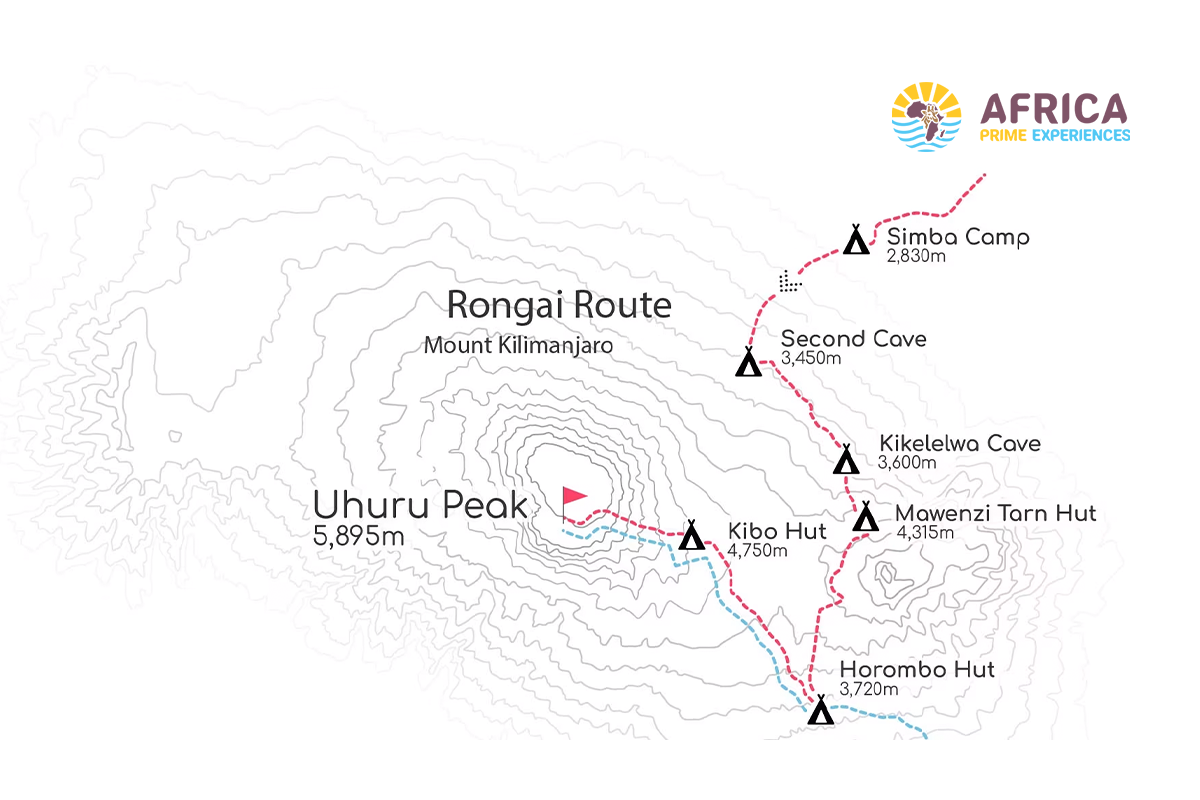
Route Map

See the route at a glance before diving into each day.

Kilimanjaro route map
Journey

Day by Day Itinerary

A clear day-by-day breakdown so you know what to expect from start to finish.

Day 1

Arrival in Kilimanjaro

You will be picked up at the Kilimanjaro International Airport (JRO) by an Taza Safaris representative and transferred to your hotel in Moshi town. Your guide will brief you on your upcoming trek and do an equipment check to make sure you have all the necessary mountain gear. Gear which is missing can be rented on this day.
Stay: Kibo Palace Hotel
Day 2

Nalemoru Gate (1990m/6529ft) → Simba Camp (2625m /s612ft)

This morning, we will drive to the village of Nale Moru for the starting point of the Rongai route. The first stage of the trek is through farmland and pine forests. You may have chance to see the beautiful Colobus monkeys or if you’re lucky enough, elephants or buffalos en route. Our first camp will be the Simba Camp located at the edge of the moorland zone.
Distance: 8km / 5mi
Duration: 4 – 5 hours
Stay: Simba Camp
Day 3

Simba Camp (2625m/8612ft) → 2nd Cave Camp (3480m/1417ft)

The morning hike is a steady ascent up to the Second Cave Camp located in the moorland zone with superb views of Kibo and the Eastern ice fields on the crater rim.
Distance: 5km / 3.1mi
Duration: 3 – 4 hour
Stay: 2nd Cave Camp
Day 4

2nd Cave Camp (3480m/11417ft) → Kikelelwa Camp (3630m /11909ft)

Leaving the pine forest behind we carry on with a steady ascent walking through moorland. There are superb views of the Eastern ice fields on the crater rim of Kibo, the highest of the three volcanoes which form the mountain. We will leave the main trail and strike out across moorland on a smaller path towards the jagged peaks of Mawenzi, the second of Kilimanjaro’s volcanoes. We will set up camp today in the sheltered valley near Kikelewa caves.
Distance: 5km / 3.1mi
Duration: 3 – 4 hours
Stay: Kikelelwa Camp
Day 5

Kikelelwa Camp (3630m/1909ft) → Mawenzi Tarn Hut (4310m/14140ft)

This morning, we have a short but steep ascent up grassy slopes which is rewarded by a superb view of the Kenyan plains to the north. We leave vegetation behind shortly before reaching our next camp at Mawenzi Tarn Hut directly below the towering cliffs of Mawenzi. This afternoon you have chance to rest or explore the surrounding area to aid acclimatization.
Distance: 8km / 5mi
Duration: 4 -5 hours
Stay: Mawenzi Tarn Hut
Day 6

Mawenzi Tarn Hut (4310m/14140ft) → Kibo Hut (4700m/15420ft)

After a good night’s rest and breakfast, we set off on our walk to Barafu camp at 4640m. The climb will take us across desolate scree slopes with no vegetation around us at all. It’s a tough steep walk made more difficult by the altitude. On arriving at camp we eat and spend the afternoon resting as we prepare for a long night and day ahead. It is important to keep hydrated and warm. We have an early dinner and then try to get some sleep as we will be getting up at between 11pm and 12pm to start the climb to the summit.
Distance: 8km / 5mi
Duration: 5 – 6 hours
Stay: Kibo Hut
Day 7

Kibo Hut (4700m/15420ft) → UHURU PEAK (5895m /19340ft) & down to Horombo Hut (3700m/12139ft)

Today is “The Big Day” – the summit stage. You will begin your final ascent around midnight which will be long and strenuous. Passing the Hans Meyer Cave at 5220m (17126ft), the climb slowly but surely goes upwards. At sunrise, you will reach Gillman’s Point (5681m) – the crater rim of Kilimanjaro – where the sun will slowly start to warm up the land. You will have soon forgotten the cold of the night and after a further hike of 1-2 hours, you will reach Uhuru Peak at 5895m (19340ft). On your return to Kibo Hut, a warm meal awaits you followed by a 1-2 hour break before proceeding back down to Horombo Hut.
Distance: 22km / 13.7mi
Duration: 12 – 15 hours
Stay: Horombo Hut
Day 8

Horombo Hut (3700m /12139ft) → Marangu Gate (1860m /6102ft)

The last stage passes through the heath and moor zone to the Mandara Hut (2700m) where a warm lunch is waiting for you. Soon, you will once again pass the tropical rainforest and after a total time of 6 hours trekking, you will be back at the Kilimanjaro National Park Gate (1860m). After saying goodbye to your mountain guides, a short transfer follows to take you back to your hotel in Moshi. Once there, you can take a warm and relaxing shower and celebrate your success in reaching the summit of Kilimanjaro.
Distance: 20.8km / 12.9mi
Duration: 7 – 8 hours
Stay: Kibo Palace Hotel
Day 9

Depart Kilimanjaro

The day is left free to wind down after the trek before your flight home. Depending on flight times you could go and explore Moshi town and grab some souvenirs before heading to the airport.
We also welcome you to spare an hour of your day to plant a tree, as part of our environmental conservation efforts in the Kilimanjaro region. Safari and Zanzibar add-ons are available if you wish to continue exploring Tanzania.
End of Itinerary
What's covered

Included & Excluded

Know exactly what's part of your package so you can plan and budget with confidence.

Included
  • Airport transfers
  • Professional mountain guides, cooks & porters
  • All park fees & permits
  • Accommodation as listed
  • All meals on the mountain
  • Rescue & safety equipment
  • Pre-trek briefing
  • Summit certificate
  • Fair porter treatment policy
  • Tipping ceremony organization
Excluded
  • International flights
  • Visa fees
  • Travel insurance
  • Personal trekking gear
  • Tips for mountain crew
  • Alcoholic drinks
  • Optional activities
  • Safari/Zanzibar extensions
Investment

2025/2026 Rates

Prices are quoted in USD per person sharing, based on group size. No hidden fees.

Group Size Mid-Range
2 Travelers $3,009
4 Travelers $2,859
6 Travelers $2,708
8 Travelers $2,648
10 Travelers $2,558

FAQs

Quick answers to common questions about this trip.

What makes the Rongai Route unique compared to other Kilimanjaro routes?
The Rongai Route is unique because it starts on the northern side of Kilimanjaro, near the Kenyan border. It offers less crowded trails, spectacular views of Mawenzi Peak, and a chance to experience different, quieter landscapes compared to the southern and western routes.
How long does it take to complete the Rongai Route?
The Rongai Route typically takes 6 to 7 days to complete. The extra day is often recommended for acclimatization, improving the chances of reaching the summit successfully.
What is the success rate of the Rongai Route?
The summit success rate for the Rongai Route is approximately 70%, which is higher than the Marangu Route. The gradual ascent and gentle slopes help with acclimatization, increasing the likelihood of success.
Is the Rongai Route suitable during the rainy season?
Yes, the Rongai Route is an excellent choice during the rainy season (April and May) because the northern side of Kilimanjaro remains dry, while the southern and western routes tend to be wet and muddy.
Is the Rongai Route good for beginners?
The Rongai Route is suitable for climbers of varying fitness levels, including beginners. Its gentle ascent, manageable terrain, and ample time for acclimatization make it a good option for those new to high-altitude trekking.
Where is Mount Kilimanjaro located?
Mount Kilimanjaro is situated in northern Tanzania, near the Kenyan border, within Kilimanjaro National Park.
Do I need technical climbing skills to summit Kilimanjaro?
No. Kilimanjaro is a non-technical climb, meaning no ropes or specialized climbing gear are required. However, good physical fitness and proper acclimatization are crucial to reach the summit successfully.
What happens if some members need to turn back before the summit?
No one is forced to go on. There is always enough staff to split the group accordingly to needs and regroup later at the camp. Most people have no trouble reaching the highest campsite. If some members decide not to climb the final distance to the peak or cannot proceed at any point in time, they can wait for the other group climbers to come back, or can go down with a guide following the same way, or take a lateral path to the descent route.
Can I hike Mount Kilimanjaro without a tour company?
No, you need a tour company when hiking Mt Kilimanjaro, because the minimum number of days to hike Mt Kilimanjaro is 5 days. During this time you need food, water, and someone to guide you and carry some of your needs (items/materials). All these services are provided by a tour company. The regulation was established to guide this activity and therefore TANAPA deals with Tanzania-registered tour companies when doing all climbing arrangements and not natural individuals.
Is airport transfer included?
Yes, we provide complimentary pick-up and drop-off from Kilimanjaro International Airport (JRO) or Arusha Airport (ARK) for all our package bookings.
Do I need a Visa for Tanzania?
Most travelers need a visa. You can obtain an E-Visa online beforehand or a Visa on Arrival ($50 USD or $100 USD for US citizens). Please check your specific country requirements.
What about dietary requirements?
We cater to all dietary needs including vegetarian, vegan, gluten-free, and halal. Please inform us at the time of booking so our chefs can prepare accordingly.

Preparation

Packing List Background
Free Guide

Kilimanjaro Gear Guide

Summit success depends on the right gear. Download our comprehensive trekking equipment list.

Download Gear List

Inquire Now

Tailor this journey

No commitment—we'll send a personalised quote and answer any questions.

Secure & Confidential

Speak to a Designer

+255 742 078 310